After more than twenty years dedicated to European project development, I continue to believe deeply in the value of Erasmus+ and its ability to transform not only the people who take part in mobility activities, but also schools and local communities.
I have experienced several generations of European educational cooperation, from the Socrates programme to the Lifelong Learning Programme and today's Erasmus+. I have worked with different approaches, supporting schools in building partnerships and in planning and managing mobility activities.
This long experience has allowed me to observe the programme's evolution closely, recognise its progress and identify some of its shortcomings.
It is precisely because I continue to believe in the value of Erasmus+ that I now feel the need to share a reflection on the current KA1 model in School Education.
A model that has undoubtedly expanded mobility opportunities but which, in my view, has some structural limitations worth examining as we look towards the 2028–2034 programming period.
The first concerns joint project development.
Erasmus accreditation is based on an Erasmus Plan, through which each institution identifies its needs, objectives and internationalisation strategies. This is certainly a valid approach to supporting organisational development and ensuring continuity in European experiences.
But how much space remains for building a genuine joint educational project between schools in different countries, defined and agreed from the application stage?
I remember Comenius school partnerships and, later, KA219 and KA229. For two or three years, schools worked together on a common theme: they planned activities, tested methodologies, compared results, faced difficulties and built relationships.
Of course, those partnerships also had organisational and management limitations, and their results did not always live up to expectations.
But they had an element I consider fundamental:
Mobility was not the project. It was one of the tools through which the project was delivered.
And that made an enormous difference.
I still remember the end of many partnerships. Some people cried because they would miss their European colleagues, while others — let us say it with a smile — were relieved at the thought of no longer having to work with certain partners!
These were, nevertheless, relationships built over time through shared work.
Today, I wonder how much of that project dimension remains.
Today's KA1 offers valuable opportunities: job shadowing, training courses, individual and group pupil mobility. These experiences can generate learning, personal growth and teaching innovation. But is the sum of many mobility activities, however interesting, enough to produce the same educational and organisational impact as a partnership built around shared objectives and responsibilities?
Over the years, I have repeatedly heard teachers return satisfied from mobility activities and comment: “Lovely, interesting, but the old projects were something else!!!”
This is not a judgement that can be generalised, of course, but it is a consideration that, in light of my experience, deserves attention.
There is a second aspect I would like to explore: the geography of Erasmus opportunities.
How many schools in peripheral or rural areas, or simply places with less tourist appeal, manage to become mobility destinations?
In my professional experience, I have observed, not infrequently, that the destination is chosen before the host institution and its actual relevance to the learning objectives.
A school in Madrid or Dublin may seem more desirable than a school in the hinterland of any European country, even when the latter has particularly interesting educational expertise and experience.
Likewise, a destination such as Iceland can have an irresistible appeal for a training course, regardless of the quality and relevance of the training offered compared with other, perhaps more interesting, options in less familiar places.
Do not misunderstand me. Discovering the local area, cultural experiences and opportunities to socialise are integral parts of the Erasmus experience.
But when the destination drives the choice of learning experience, rather than the other way round, I believe it is legitimate to question how consistent that choice is with the programme's aims.
Another issue concerns reciprocity in cooperation.
How many of us have searched, often unsuccessfully, for schools willing to host groups of pupils on mobility in Northern European countries? In my experience, very few are available, and not necessarily because they lack international openness, but because hosting requires time, staff and a reorganisation of normal teaching activities.
This is understandable. Yet this is precisely where, in my view, a weakness of the model emerges: without a common project, some of the mutual motivation to invest time and resources in cooperation also disappears.
How balanced can a system be when some schools continually seek mobility opportunities — mainly those from Southern Europe — while others do not have the same motivation, considering the traditional curriculum far more important than international mobility, especially when it comes to hosting?
I do not claim to have definitive answers. Nor do I mean to suggest that all experiences delivered under today's KA1 are less effective than earlier ones.
I do, however, have the impression that the sense of belonging to a European educational community that works together over time towards a common result has weakened to some extent.
Accreditation has undoubtedly introduced significant benefits for individual schools: long-term access to European funding, multiannual planning and the assurance of involving pupils in international mobility every year. These achievements deserve recognition.
But they should not prevent us from critically assessing what risks working less well in the current approach, beginning with the growing difficulty of obtaining accredited school status because of more complex application forms and stricter selection.
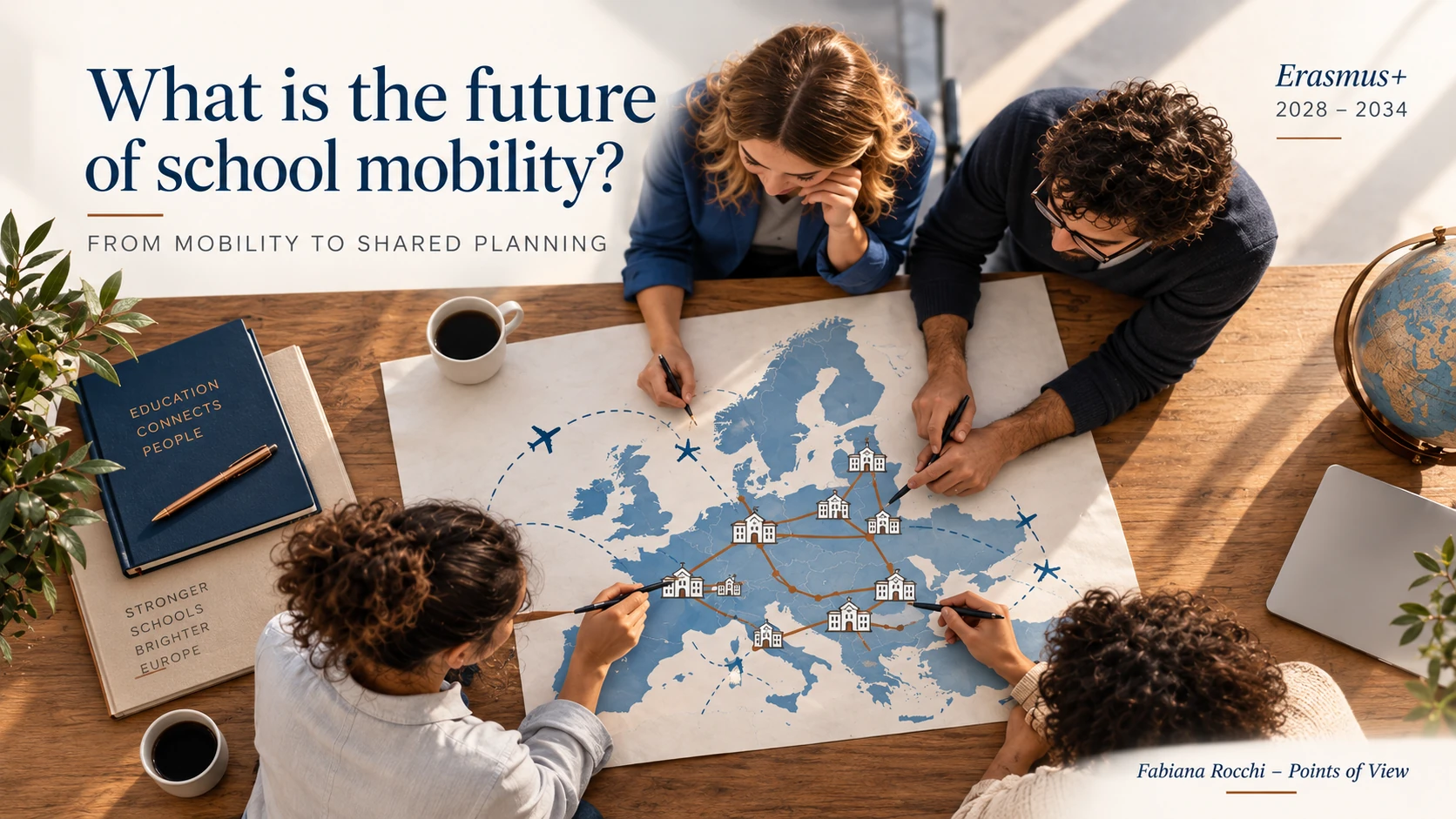
Looking ahead to 2028–2034, I hope this model can be reconsidered, restoring a project dimension in which schools are called upon to build common pathways from the application stage, with shared objectives, activities, responsibilities and results.
This is not about going back to the past, but about recovering what worked and combining it with the positive aspects of the current system.
Because the success of Erasmus+ should not be measured only by how many people cross a border, but above all by what changes in schools and local communities after that border has been crossed.
I would like to hear from those who, like me, have experienced several generations of the programme, as well as teachers and school leaders who have known only the current model.
Were school partnerships really more capable of generating cooperation and lasting impact? Or are those of us who experienced them attached to a different idea of internationalisation?
I would like to open a professional discussion, including with people whose views are completely different from mine.
Because, beyond the tools and funding arrangements, I believe we should continue to ask ourselves a fundamental question: what kind of Erasmus do we want for our schools over the next seven years?