
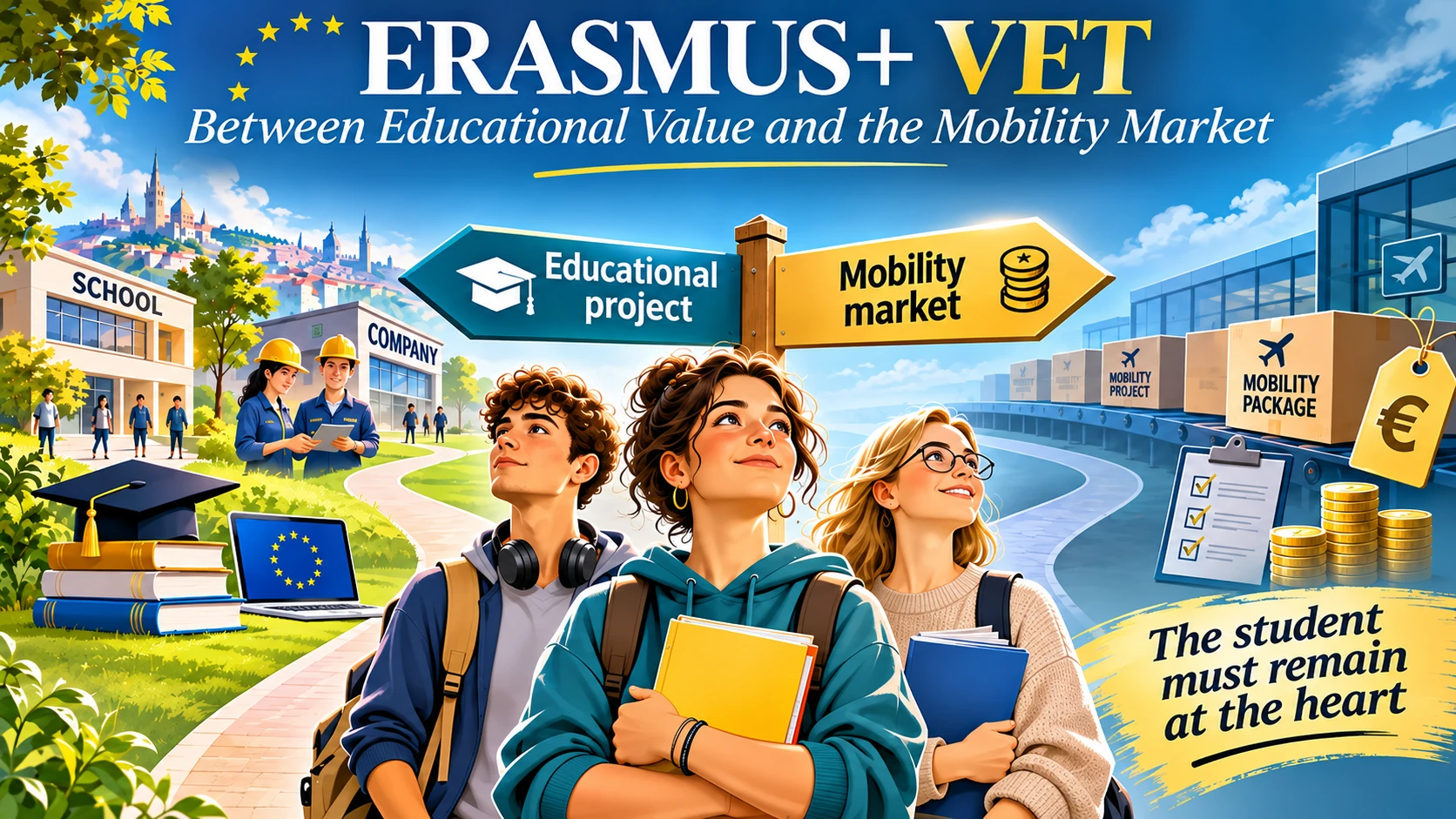
For over twenty years, I have been working in European project development, supporting educational institutions, both in Italy and abroad, in their internationalisation processes. As an independent consultant and external Erasmus+ expert, I facilitate partnership development, cooperation between educational institutions and the organisation of transnational mobilities.
Recently, however, I have noticed a trend that deserves some reflection.
Increasingly, when contacting European schools interested in developing Erasmus+ partnerships, I receive remarkably similar responses: “We prefer to work independently”, “We do not need support organisations”, “Our National Agency has advised us to avoid intermediaries”.
These responses come from institutions in different countries, from Romania and Türkiye to Spain, and seem to reflect an increasingly widespread attitude.
A school's decision to manage its own mobility activities independently is, of course, entirely legitimate and deserves to be respected.
THE PROBLEM ARISES WHEN ANY PROPOSAL FOR COLLABORATION FROM AN EXTERNAL PROFESSIONAL IS AUTOMATICALLY INTERPRETED AS AN ATTEMPT BY A SUPPORT AGENCY TO BECOME INVOLVED IN PROJECT MANAGEMENT.
Whether the person concerned is an independent consultant, an internationalisation expert or a professional who has spent years building European educational networks seems to make little difference. These distinctions sometimes appear to disappear behind a single label: intermediaries to be avoided.
I therefore wonder whether, in the entirely legitimate effort to tackle questionable commercial practices and safeguard project quality, we are creating an equally worrying side effect: widespread mistrust of anyone offering professional expertise from outside the beneficiary institutions.
I am not suggesting that this necessarily reflects the official position of National Agencies. Erasmus+ rules do not impose an absolute ban on the involvement of support organisations, let alone collaboration with external experts.
Rather, I am referring to the way certain recommendations appear to be received and interpreted by numerous educational institutions, to the point where they become an almost automatic reaction: if an external organisation or professional proposes a collaboration, it is probably better to avoid it.
But are we sure that such generalisation genuinely supports internationalisation?
More importantly, are we sure that those encouraging schools to reduce their reliance on external support fully appreciate the practical difficulties involved in organising Erasmus+ mobility activities abroad?
This is precisely where a contradiction emerges which, in my professional experience, becomes particularly apparent when moving from short-term school mobilities to international work placements in vocational education and training.
A five-day school mobility is not the same as a three-month VET placement
Let us consider a short-term school mobility.
An Italian school establishes contact with a Spanish, French or German school. The two institutions share a professional language, understand how their respective education systems work and, above all, are familiar with the aims and procedures of an Erasmus+ project.
Organising five days of educational activities, visits and exchanges certainly requires effort, but the involvement of two educational institutions sharing common objectives and responsibilities makes the process considerably easier.
When it comes to VET mobility, however, the situation changes dramatically.
It is no longer simply a matter of connecting two educational institutions.
It means building a bridge between education and the business world, often in countries where companies have little or no familiarity with Erasmus+.
A Spanish vocational college, for example, may need to arrange placements for its students in Italian companies for periods of two or three months.
But how can a foreign institution, with no established local network, identify companies willing to host these students?
And, perhaps more importantly, why should a company agree to do so?
The business perspective: an often underestimated reality
Let us look at the situation from an employer's perspective.
An Italian company receives an email from a foreign school asking it to host one, two or three students for a work placement.
The employer may know little about Erasmus+, have no experience of international mobility and not immediately understand the responsibilities involved in hosting students.
Accepting a student means appointing a workplace mentor, devoting time to their training, integrating them into the company's activities, dealing with possible language barriers and ensuring appropriate learning and safety conditions.
All of this requires an organisational commitment, often without any specific remuneration for the mentoring provided.
Naturally, the company may also benefit from the experience by engaging with young people from different education systems and developing a more international outlook. However, these benefits need to be explained, developed and made credible.
Simply sending an email from abroad and expecting a positive response is not enough.
What is needed is someone who understands the local business environment, can identify companies whose activities match the students' vocational profiles and can establish relationships based on trust. Someone who can meet employers in person, explain the project, clarify responsibilities and support the company throughout the experience.
This work of relationship-building and mediation does not happen automatically when an international agreement is signed. It is the result of local knowledge, professional credibility and relationships built over time.
The accommodation challenge: who provides guarantees for the students?
Alongside the difficulties of finding suitable companies, there is another equally practical issue: accommodation.
Finding accommodation for a mobility lasting a few days is relatively straightforward. Arranging accommodation for a group of students staying for two or three months, however, can be extremely complicated.
The short-term and temporary rental market is not necessarily designed to meet the needs of Erasmus+ projects. A landlord may be reluctant to rent a flat to young people from abroad whom they do not know, for a limited period and without the guarantees normally required.
Who signs the tenancy agreement? Who is responsible for any damage? Who intervenes if problems arise in the accommodation? Who deals with an emergency when the sending institution is thousands of kilometres away?
These are practical questions that cannot be answered simply by referring to the beneficiary organisation's overall responsibility. An organisational structure is needed to anticipate difficulties and respond promptly when problems arise.
Once again, having a reliable local contact can make the difference between a well-organised mobility and a problematic experience.
A local contact is not necessarily an intermediary who compromises quality
This is precisely why we need to move beyond an oversimplified view of support organisations.
There is a fundamental difference between an organisation that takes over the management of a school's project and a professional or organisation that provides expertise, local networks and operational capacity.
In the first case, the risk is clear: the beneficiary may lose effective control of its own project, creating a paradoxical reversal of roles, from being the “master” to becoming the “servant”.
In the second case, local support can be an essential means of ensuring the quality of the experience.
After all, Erasmus+ rules themselves recognise this distinction.
The question, therefore, should not simply be whether a beneficiary organisation makes use of external support. It should be what role that external provider plays, what expertise it brings, how its work is supervised and what measurable results it delivers.
The question National Agencies should be asking
In my view, the central issue is not whether beneficiary organisations should retain responsibility for their projects. There can be no doubt about that principle.
The real question is this: how can we expect increasingly high-quality, inclusive and long-term VET mobilities if we fail to recognise the value of the work required to make them possible?
Tackling intermediaries who undermine quality is essential. However, placing those who commercialise standardised mobility experiences of questionable educational value in the same category as those who genuinely develop work placement opportunities, build relationships with companies and organise appropriate hosting arrangements means failing to recognise the complexity of vocational mobility.
The risk is that a measure intended to protect quality may, in practice, make the work of those who help ensure it more difficult.
The quality of an Erasmus+ project does not depend on the absence of external support. It depends, above all, on the ethical values of those involved, their professional competence, clearly defined responsibilities and their ability to create authentic learning experiences.
And it is the distinction between commercialisation and educational responsibility that should form the starting point for any reflection on the future of VET mobility.